

There is a common belief in the specialty coffee world that coffee is at its pinnacle the second it drops from the roasting drum into the cooling tray. We are conditioned to look for the most recent "Roast Date" stamped on a craft bag, assuming that brewing on day one guarantees the freshest, most vibrant cup possible.
In reality, drinking coffee the day it was roasted is one of the quickest ways to ruin a premium bean.
Freshly roasted coffee beans are not ready to be brewed immediately. They are undergoing a critical thermodynamic and chemical transformation known as degassing. Without allowing your coffee to rest for an engineered period, the trapped carbon dioxide inside the cellular structure actively interferes with extraction, muting complex flavor notes and creating a sharp, metallic acidity in your cup.
Here is the science behind why fresh coffee must rest, how degassing dictates extraction physics, and why we engineer our roasting curves specifically for direct-to-doorstep delivery.
1. The Chemistry of Roasting and Gas Entrapment
During the roasting cycle, raw green coffee undergoes the Maillard reaction and caramelization under intense heat (often reaching 400°F to 440°F). As organic matter breaks down and cellular moisture evaporates, immense pressure builds inside the bean.
One of the primary byproducts of this thermal breakdown is carbon dioxide (CO2).
When the roast is terminated and the beans are quickly cooled, a significant volume of CO2 remains trapped within the porous, sponge-like matrix of the coffee cellulose. A standard 12oz bag of whole bean coffee can hold several liters of compressed gas immediately post-roast.
Over the following days, this gas slowly escapes through microscopic cellular pores. This passive release is what puffs up sealed coffee bags with one-way degassing valves.
2. Why Trapped CO2 Destroys Brew Extraction
When hot water touches freshly ground coffee, two separate phenomena take place: desorption (gas release) and dissolution (flavor extraction).
If your beans are too fresh (e.g., 24 to 48 hours off the roaster), the volume of escaping CO2 is violent and overwhelming.
The Micro-Channeling Catastrophe
In both espresso and pour-over brewing, water needs to make uninterrupted, uniform contact with the soluble coffee solids. When grounds are loaded with gas:- The Gas Barrier: As hot water saturates the grounds, the rapidly escaping CO2 pushes water away from the coffee particles.
- Channeling: Water takes the path of least resistance, forcing microscopic fissures (channels) through the coffee bed.
- Uneven Extraction: The coffee directly bordering the channels becomes severely over-extracted and bitter, while the rest of the coffee bed remains dry and under-extracted.
The Carbonic Acid Bite
CO2 dissolves into brew water to form carbonic acid. When brewing day-old beans, this excess carbonic acid creates a harsh, fizzy, sour-metallic tang on the palate that masks the natural dark chocolate, brown sugar, and fruit notes inherent in the bean.3. The GoldPool Engineered Maturation Curve
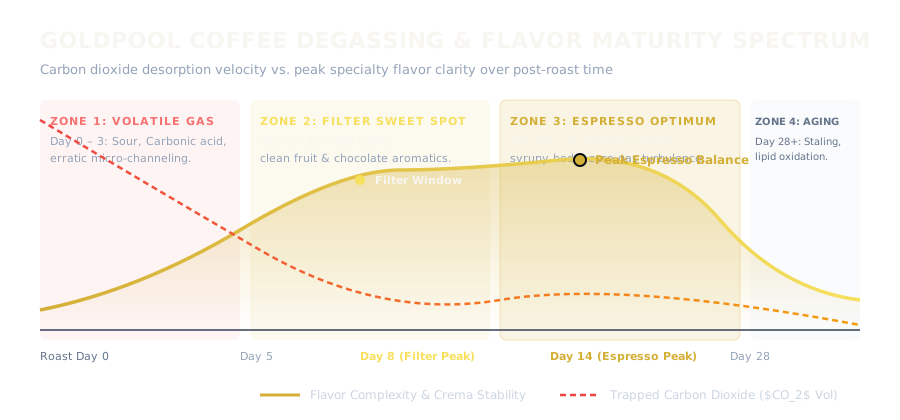
A Critical Distinction: Not every coffee in the world peaks at the identical time. In fact, very few roasters design their roast profiles and development times for direct online delivery versus local walk-in cafe hoppers.
Degassing velocity depends heavily on origin density, roasting thermodynamics, and blend structure. Darker commodity roasts develop high porosity and quickly turn stale within days, while dense single origins can remain turbulent for weeks.
At GoldPool Coffee, we engineer our roasting profiles, bean density alignment, and delivery dispatch so that our coffees reach you right at their engineered sweet spot:
| Brew Method | Minimum Rest | Peak Flavor Window | Flavor Profile Behavior |
|---|---|---|---|
| Filter / Pour Over | 5 Days | Days 7 – 21 | High clarity, bright acidity, and clean caramel finish emerge. |
| Espresso Extraction | 10 Days | Days 10 – 24 | Dense velvety crema, syrupy body, zero carbonic turbulence. |
| Cold Brew | 3 Days | Days 5 – 25 | Extended immersion steep times tolerate slightly fresher beans. |
4. How GoldPool Solves the Freshness Paradox for Online Delivery
One of the biggest frustrations home brewers face is buying coffee from grocery store shelves where beans have sat for 6 months (stale and oxidized), or ordering from boutique roasters where beans arrive so fresh that you cannot brew them for a week without channeling headaches.
We designed our entire system for online delivery:
- Synchronized Scheduled Batches: We roast in synchronized small batches in Miami on 1st & 3rd Mondays.
- Immediate Transit Rest: Bags are sealed in one-way degassing valve pouches and dispatched immediately, allowing violent degassing to occur safely during transit.
- Arrival at Peak Maturity: By Day 10 post-roast when your GoldPool package lands on your counter, the coffee has naturally settled into its optimal extraction window (Days 10–24).
- Pre-Roasted Balance: GoldPool Signature blends 6 premium origins pre-roasted together as one unified batch, ensuring the entire blend de-gasses uniformly for a consistently smooth morning cup.
5. Summary & Practical Home Brewing Tips
- Don't Rush Day-One Beans: If your roast date is within the last 48 hours, resist the temptation to pull high-pressure espresso immediately.
- Store in Original Valve Bags: Keep your coffee in its sealed, valved pouch away from direct sunlight, heat, and moisture.
- Extend the Bloom for Fresh Coffee: If you brew coffee younger than 5 days on pour-over, extend your bloom time to 45–60 seconds and gently swirl to encourage gas evacuation before your main pours.

Experience The Signature Blend
6 single origins pre-roasted together in Miami for ultra-low acidity, dark chocolate ganache richness, and dense golden crema.