

For decades, one of the most widely shared pieces of kitchen advice has been simple: "If you want your coffee to stay fresh longer, just stash the bag in the freezer."
It sounds completely logical. Cold slows down biological decomposition, prevents food spoilage, and extends the shelf life of perishable groceries. But roasted coffee beans are not like frozen vegetables or meat. They are a fragile, highly porous cellular matrix packed with delicate volatile organic compounds, aromatic lipids, and micro-soluble solids.
When you store your daily coffee bag in the freezer, pulling it out each morning to scoop beans before returning it to the cold, you are not preserving freshness. In fact, you are subjecting your beans to the fastest, most destructive degradation cycle possible in home brewing.
🎬 Watch the Lab Visual on Instagram: See Professor Bean's freezer condensation experiment in action on our official Instagram feed (Reel #32 • @goldpoolcoffee).
Here is the thermodynamic and chemical science behind why daily freezer storage ruins coffee beans, how moisture condensation wrecks extraction physics, and the only scenario where freezing coffee makes scientific sense.
1. The Physics of Moisture and Condensation (The Dew Point Trap)
To understand why freezers destroy daily coffee, you have to look at the behavior of ambient humidity and temperature differentials.
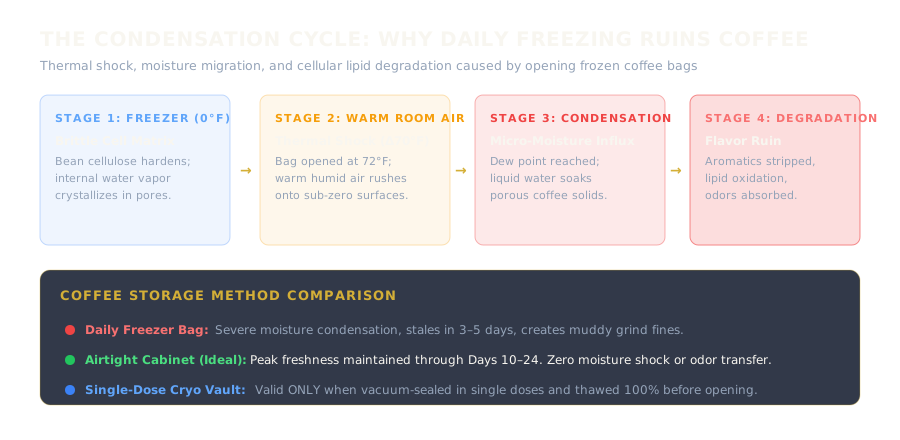
When roasted coffee is frozen at 0°F (-18°C) and you open the bag in a 72°F (22°C) kitchen, warm, moisture-laden room air instantly rushes inside. Because the surface temperature of the frozen beans is far below the dew point of the surrounding air, water vapor condenses instantly onto every single bean.
The Micro-Bath Phenomenon
Within seconds of opening the bag, your beans receive a micro-bath of liquid moisture. When you seal the bag and put it back into the freezer:- Trapped Liquid Moisture: The condensed surface water is sealed inside the cold environment.
- Ice Crystal Formation: As the water refreezes, expanding ice crystals fracture the bean's delicate cellulose walls.
- Premature Extraction: Water is a universal solvent. The micro-condensation begins dissolving and extracting soluble flavor compounds before the coffee ever reaches your grinder or portafilter.
- Lipid Saponification: Roasted coffee oils on the bean surface break down rapidly when exposed to cyclical moisture, leaving a rancid, sour aftertaste in your morning brew.
2. Roasted Coffee is a Natural Sponge (The Odor Trap)
Have you ever placed an open box of baking soda in your refrigerator to eliminate odors? Roasted coffee beans behave almost identically.
During the roasting process, raw green coffee expands, shedding cellular water and developing a dense labyrinth of microscopic pores. This structure makes roasted coffee one of the most efficient natural adsorbents on earth.
When stored in a standard household freezer alongside frozen seafood, prepared meals, onions, or lingering frost, coffee beans aggressively draw in ambient odors and volatile gases through their porous cellulose walls. Within a matter of days, the delicate dark chocolate, toasted almond, and stone fruit aromatics of a craft roast are replaced by flat, stale freezer-burn aromas.
3. How Frozen Beans Wreck Your Grinder & Extraction Consistency
Grinding consistency is the single most important physical variable in achieving balanced coffee extraction. To pull a sweet, syrupy espresso or brew a clean, vibrant pour-over, you need a uniform particle size distribution with minimal "fines" (dust-like micro-particles that cause over-extraction and bitterness).
When coffee beans undergo cyclical freeze-thaw condensation, two structural failures occur:
- Brittleness and Shattering: Sub-zero temperature changes the fracture mechanics of the bean. Instead of shearing cleanly between burrs, partially frozen or moisture-damaged beans shatter unpredictably, generating a massive spike in fines.
- Channeling in the Brew Bed: Excess fines clog filter papers and espresso baskets, creating micro-channels where pressurized water rushes through cracks, leaving the surrounding coffee under-extracted and sour while over-extracting bitter astringency.
4. The Storage Spectrum: Daily Use vs. Single-Dose Cryo Vaulting
Does this mean coffee should never touch a freezer? Not quite. There is a critical scientific distinction between daily freezer access and long-term single-dose cryo-preservation.
| Storage Method | Ideal Duration | Condensation Risk | Impact on Flavor Profile |
|---|---|---|---|
| Daily Freezer Bag (Worst) | 1 – 5 Days | Extreme (Daily thermal shock) | Rapid staling, rancid oils, muddy extractions, freezer odor taint. |
| Airtight Room-Temp Pouch (GoldPool Way) | Days 10 – 24 | Zero (Stable environment) | Peak flavor maturity, rich chocolate crema, smooth caramel sweetness. |
| Single-Dose Vacuum Cryo (Advanced) | 3 – 12 Months | Zero (Thawed completely before opening) | Preserves rare competition micro-lots when frozen once in airtight tubes. |
The Strict Rules of Specialty Coffee Freezing
If you ever intend to freeze coffee for long-term storage (such as archiving an ultra-rare GoldPool Special Reserve drop), you must follow three non-negotiable rules:- Single-Dose Only: Divide the coffee into individual, airtight vacuum-sealed glass tubes or vacuum pouches. Never freeze a multi-dose bag that you intend to open and re-close.
- Never Open Cold: When removing a single dose from the freezer, you must either grind directly while rock-solid into the hopper (immediate grind) or allow the sealed container to reach room temperature completely for 2 to 3 hours before breaking the vacuum seal.
- Never Re-Freeze: Once a dose has thawed, it must never be returned to the freezer.
5. The Real Solution: Roasted to Order, Delivered at Peak Maturity
Why do people freeze coffee in the first place? Almost always because they bought a giant multi-pound bag at a bulk store that they cannot finish before it goes stale, or because they received an erratic shipment schedule.
At GoldPool Coffee, we engineered our roast-to-order subscription model specifically to eliminate the need for freezing:
- Small-Batch Scheduled Roasts: We roast on synchronized 1st & 3rd Monday cycles in Miami.
- Natural In-Transit Degassing: Beans rest and release volatile gases safely inside one-way valve pouches during transit.
- Perfect Staggered Portions: Deliveries arrive every 14 days, landing on your doorstep right as the previous bag finishes and the new batch hits its peak maturation window (Days 10–24).
- Zero Freezers Required: Store your 12oz bag in a cool, dark kitchen cabinet at room temperature away from direct sunlight, and enjoy rich dark chocolate, cherry, and toasted almond sweetness in every single cup.
6. Summary: The Golden Rules of Coffee Storage
- Keep It in the Original Pouch: GoldPool bags feature specialized multi-layer barrier foil and one-way degassing valves designed to shield beans from light and oxygen.
- Store at Room Temperature: Keep your beans in a cool pantry or cabinet (65°F–72°F / 18°C–22°C).
- Avoid the Refrigerator Entirely: A standard fridge is even worse than a freezer because humidity levels are higher, accelerating mold and moisture spoilage.
- Buy What You Drink: Freshly roasted coffee is a living, evolving agricultural product. Drink it within its peak 3-to-4 week window for the ultimate cup.

Experience The Signature Blend
6 single origins pre-roasted together in Miami for ultra-low acidity, dark chocolate ganache richness, and dense golden crema.