

When you set your coffee grinder to a specific notch, it is natural to imagine that every single ground particle coming out of the chute is identical in size.
In reality, coffee beans shatter like microscopic glass. Every single grinding cycle produces a spectrum of particle sizes: fines (microscopic dust) and boulders (large coarse chunks).
This particle size distribution is the single biggest factor determining whether your cup tastes sour and thin, bitter and astringent, or rich and balanced.
1. The Bimodal Reality of Coffee Grinding
No grinder in the world produces 100% uniform particles. Most specialty burrs create a bimodal distribution:
- Fines (<100 microns): Microscopic dust particles generated when bean cell walls shatter. They extract almost instantaneously.
- Target Grounds (400–800 microns): The intended particle size that dissolves sweet sugars and aromatics over 2 to 4 minutes.
- Boulders (>1000 microns): Oversized chunks that hot water cannot fully penetrate before the brew finishes.
The Danger of Excess Fines: Filter Clogging & Channeling
When a grinder generates too many fines, they migrate to the bottom of your filter paper or espresso basket, forming an impenetrable barrier known as fines migration. Water backs up, extraction stalls, and high pressure forces micro-channels through the bed, pulling harsh ash and astringency into your cup.2. Burr Geometry: Flat Burrs vs. Conical Burrs
The shape and alignment of your grinder burrs dramatically dictate your particle size distribution curve:
Flat Burrs (High Unimodal Clarity)
- Design: Two parallel donut-shaped rings spinning at high RPM.
- Flavor Profile: Narrower particle size distribution with fewer boulders. Yields laser-sharp flavor clarity, floral definition, and sweet origin separation.
- Ideal For: Modern espresso and light-to-medium pour-overs.
Conical Burrs (Bimodal Texture & Crema)
- Design: A cone-shaped inner burr spinning inside a matching outer ring.
- Flavor Profile: Produces a wider bimodal distribution with a healthy percentage of fines.
- Flavor Impact: Delivers heavy mouthfeel, syrupy body, and rich crema density that holds up wonderfully in milk drinks.
- Ideal For: Classic espresso blends and everyday drip coffee.
3. Freshness and Rested Beans: How Degassing Affects the Grind
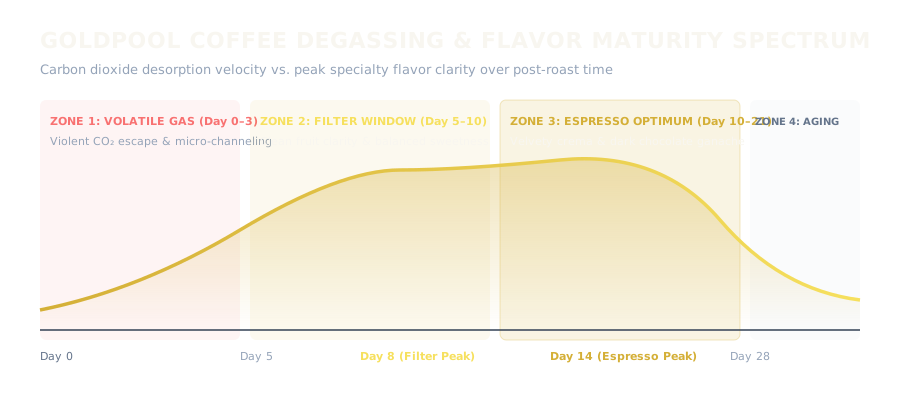
Freshly roasted coffee contains high volumes of internal CO₂ pressure. If beans are ground immediately on roast day, gas rapidly expands inside the grinder chute and portafilter, causing irregular particle shattering and severe fines generation.
Allowing beans to rest in their sealed valved pouches across the 5 to 10 day resting window allows cellular pressure to stabilize. Rested beans grind with significantly narrower particle distribution, reducing bitter dust and maximizing sweet extraction clarity.
4. Professional Framework: Dialing in by Taste
Grinder calibration numbers are completely arbitrary. A "setting 5" on one grinder is completely different from a "setting 5" on another.
Here is the professional barista framework for dialing in your grind:
| Taste Symptom | Extraction State | Grind Adjustment |
|---|---|---|
| Sour, salty, thin body, fast brew time | Under-extracted | Grind Finer (increase surface area & contact time) |
| Bitter, dry tongue, astringent, muddy bed | Over-extracted | Grind Coarser (decrease fines & contact time) |
| Sweet, heavy chocolate finish, clean aftertaste | Balanced Sweet Spot | Lock Setting (hit target drinking balance) |
Recommended Grind Sizes by Brewing Method
- Cold Brew: Extra Coarse (sea salt texture, 1000µm–1200µm)
- French Press: Coarse (coarse kosher salt, 800µm–1000µm)
- Pour-Over & Aeropress: Medium-Fine (table salt texture, 500µm–700µm)
- Espresso: Fine (powdered sand, 200µm–300µm)

Experience The Signature Blend
6 single origins pre-roasted together in Miami for ultra-low acidity, dark chocolate ganache richness, and dense golden crema.